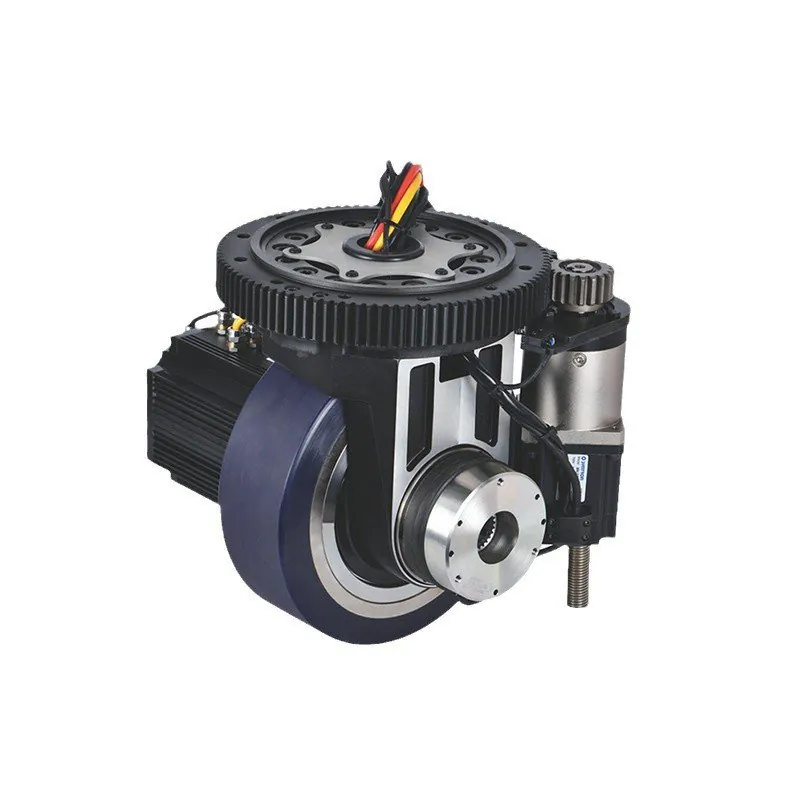
Basic composition structure of AGV steering wheel
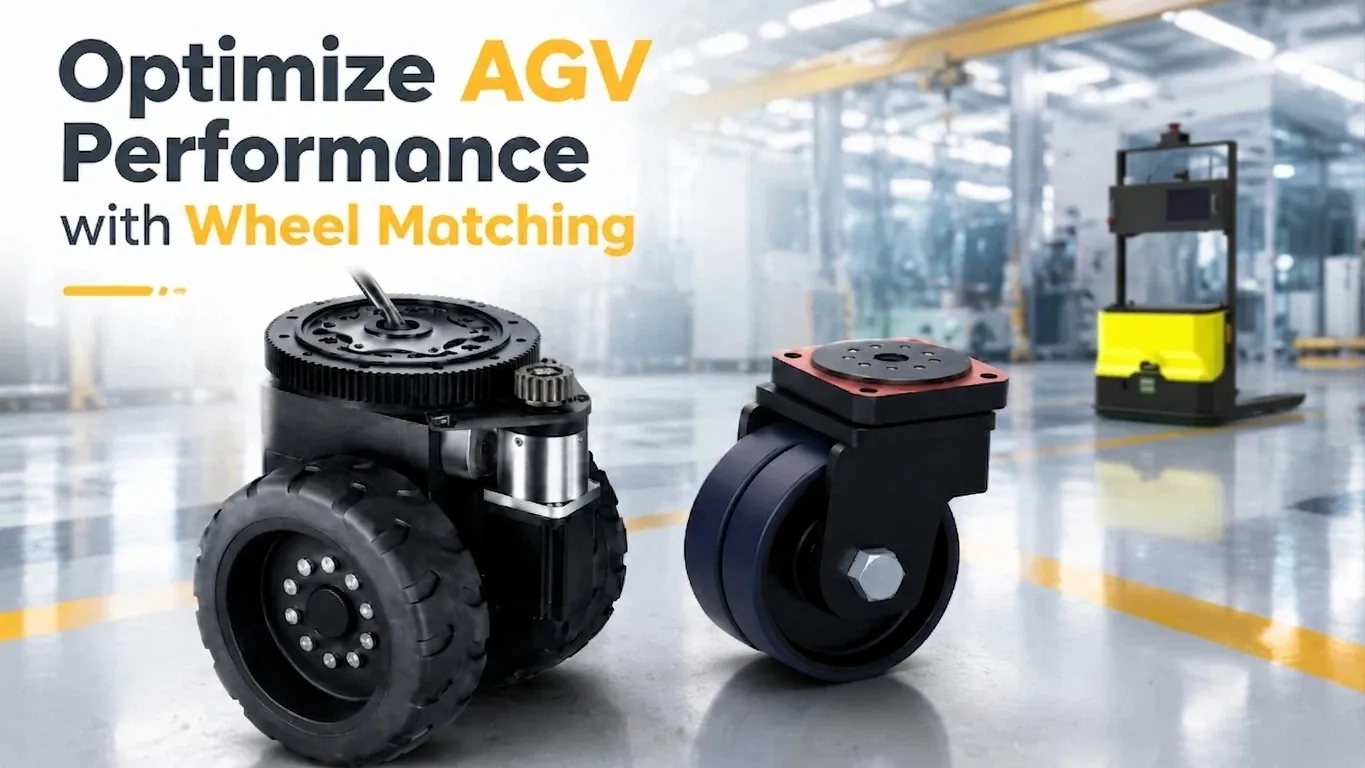
The AGV steering wheel is an important component used to control the direction of AGV (Automated Guided Vehicle) travel, with a complex and precise structure. It usually consists of the following main parts:
Walking mechanism: including walking motor, walking gearbox, rubber wheels, brake, feedback unit. The walking motor is connected to the walking gearbox, which amplifies the torque generated by the motor and outputs the required torque for the vehicle to move forward on the rubber coated wheels. The friction between the rubber wheels and the ground generates thrust, pushing the vehicle forward or backward. The brake is used for parking after parking to prevent the vehicle from moving.
Steering mechanism: including slewing bearings, steering gears, steering reducers, steering motors, electronic limit devices, mechanical limit devices, and feedback units. The steering motor controls the steering angle of the steering wheel through the steering reducer and steering gear transmission. Electronic and mechanical limit devices are used to limit the turning range of the steering wheel and prevent damage caused by excessive turning.
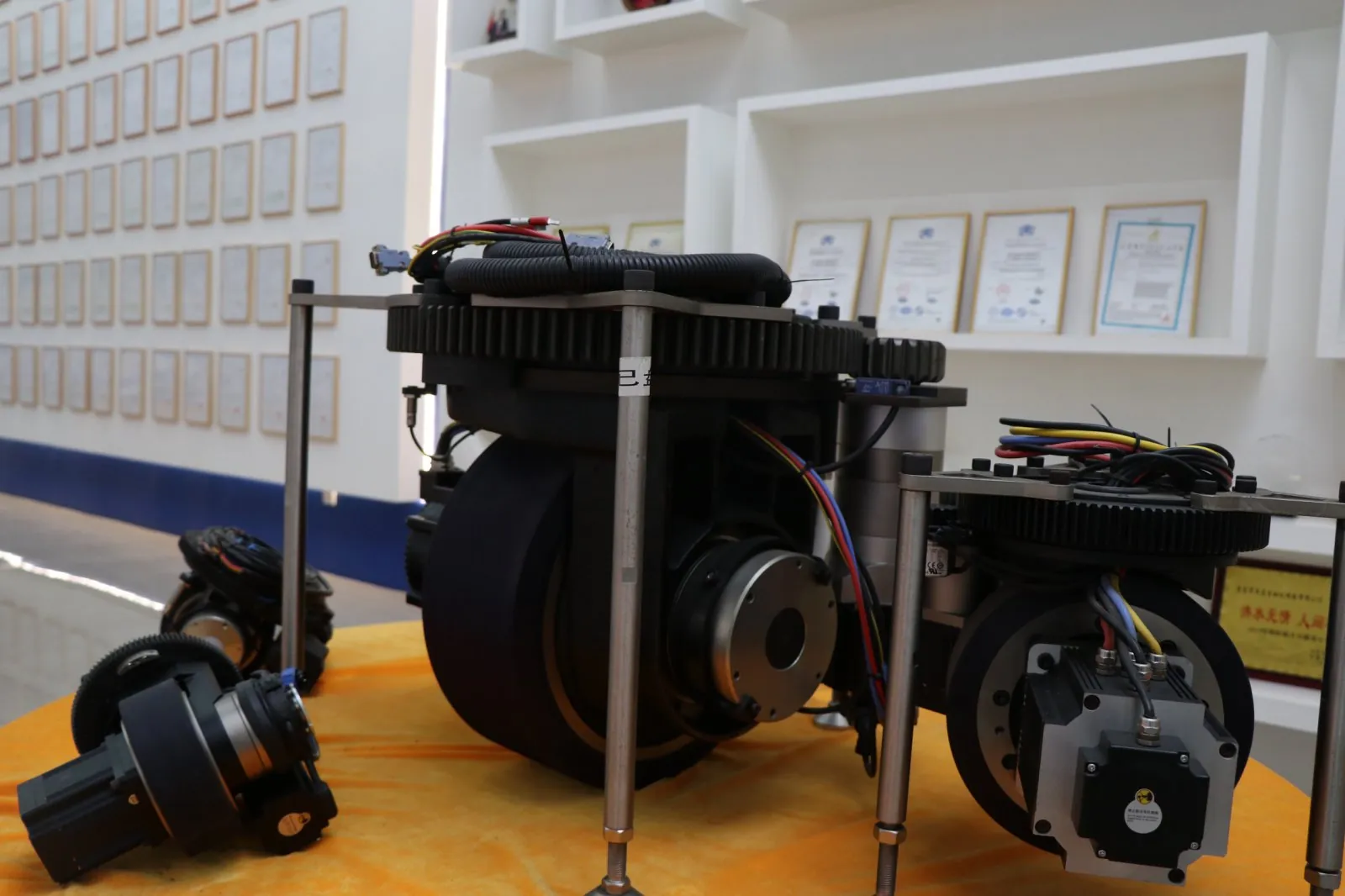
Working principle of AGV steering wheel
The working principle of AGV steering wheel is relatively complex, but the core lies in motor drive and steering control.
Working principle of walking: The torque generated by the walking motor is amplified by the walking gearbox and output on the rubber coated wheels to the required torque for the vehicle to move forward. The friction between the rubber wheels and the ground generates thrust, pushing the vehicle forward or backward. The brake intervenes when needed to achieve parking or emergency braking.
Steering working principle: When the AGV needs to change its direction of travel, the control system will send a signal to the steering motor. After receiving the signal, the steering motor starts to rotate and is driven by the steering reducer and steering gear to achieve the preset deflection angle of the steering wheel. Cooperate with the thrust generated by the walking part to achieve functions such as turning, lateral movement, and stationary turning of the vehicle. Electronic and mechanical limit devices play a protective role during the steering process, preventing excessive turning.
Key components and functions
Rotary bearing: It is a component that connects the steering wheel and the vehicle body, with the installation surface located on the outer ring of the rotary bearing. When the steering wheel turns, other components rotate around the center of the slewing support.
Limit bolt: fixed at the lower part of the outer ring of the slewing support, used to trigger electronic limit and mechanical limit when the steering wheel turns.
Electronic limit: When the steering wheel turns to a preset angle, the electronic limit signal is triggered by detecting the limit bolt to prevent excessive turning.
Mechanical limit: As a backup of electronic limit, when the electronic limit fails or the program is abnormal, the mechanical limit will block the steering wheel from further turning, preventing damage.
Feedback unit: including steering feedback unit and walking feedback unit, used to provide feedback signals to the control program, calculate the steering angle of the steering wheel and the vehicle’s speed, distance, etc.

Houzai AGV steering wheel advantage
Jieyang Houzai Electromechanical Equipment Co., Ltd., as one of the earliest domestic enterprises specializing in the research and production of AGV/AMR steering wheels and electric drive wheel assemblies, has the following advantages in AGV steering wheels:
Wide power range: Electric drive wheels and steering wheels have a power range of 0.2KW to 50KW, meeting the needs of different application scenarios.
There are various options for wheel diameter and load capacity: the wheel diameter range is 150mm to 600mm, and the load capacity range is 300KG to 20000KG, almost covering the needs of various electric drive mobile equipment in the industrial field.
Personalized customization: Customization can be made according to the personalized needs of customers to create exclusive products.
Strong technical strength: Obtained over 40 patents and established an excellent supply chain foundation for core components such as motors, gears, and drive control systems.
In summary, the Houzai AGV steering wheel has the advantages of complex and precise structure, complex but efficient working principle, complete and reliable key component functions, as well as strong technical strength and customization. These advantages have enabled Phoenix Power AGV steering wheels to be widely used in fields such as automated logistics and intelligent manufacturing, and provide customers with high-quality electric drive solutions.
AGV Steering Drive Wheel Specifications
| Parameter | Range |
|---|---|
| Power Range | 0.2 kW – 50 kW |
| Wheel Diameter | 150 mm – 600 mm |
| Load Capacity | 300 kg – 20,000 kg |
| Steering Angle | ±140° (single-wheel models) or 360° continuous rotation (select models) |
| Steering Mechanism | Slewing bearing, steering motor, steering reducer, steering gear |
| Limit Protection | Electronic limit + mechanical limit (backup) |
| Feedback | Steering feedback unit + walking feedback unit |
| Customization | Available based on individual application needs |
AGV Steering Drive Wheel vs. Standard Drive Wheel
| Factor | AGV Steering Drive Wheel | Standard Drive Wheel |
|---|---|---|
| Steering Mechanism | Independent steering motor + slewing bearing + reducer, enabling turning, lateral movement, and stationary (in-place) turning | None — relies on differential speed between wheels, or fixed single-direction travel only |
| Load Capacity | Covers the full 300 kg – 20,000 kg range depending on model | Generally supports a narrower load range, since it lacks the added steering assembly |
| Installation | Requires slewing bearing and steering motor — more complex mounting footprint | Simpler mounting, fewer moving parts |
| Movement Capability | Turning, lateral movement, and in-place turning | Forward/backward travel only, or arc turns via differential drive |
| Typical Application | AGVs needing omnidirectional movement or tight-space maneuvering | AGVs on fixed, simple routes where directional flexibility is not required |
Frequently Asked Questions (FAQ)
What is an AGV steering drive wheel?
An AGV steering drive wheel is a wheel assembly that both drives an AGV forward and controls its direction, combining a walking mechanism and a steering mechanism in one unit.
How does an AGV steering wheel work?
A walking motor drives the wheel through a gearbox for forward and backward motion, while a separate steering motor turns the wheel through a slewing bearing and steering reducer to change direction.
What is the difference between an AGV drive wheel and a steering wheel?
A standard drive wheel only moves the AGV forward or backward, while a steering wheel adds a rotating mechanism that lets the wheel turn to change the vehicle’s direction, including lateral and in-place turning.
Can the steering angle be customized?
Yes, the steering mechanism can be adjusted and customized based on specific application needs, alongside customization of power, wheel diameter, and load rating.
What industries use AGV steering drive wheels?
They are widely used in automated logistics and intelligent manufacturing, including warehousing, production line material handling, and mobile robotics.
Why choose Houzai’s AGV steering wheels over standard options?
Houzai has over 40 patents in this category and a wide range of customizable specifications, allowing the wheel to be tailored to a customer’s exact power, load, and mounting requirements rather than using a one-size-fits-all design.